Tuesday
Apr142015

The Zeitgeist


A typical Jewish tombstone (left) and a Yahrtzeit (memorial) candle.


The End of Mourning:

Closure on a Year of Remembrance 


The Ba’al Tefila (prayer leader) was old, probably in his 80s, his complexion wan, his hair snow white and thin, his posture stooped, but his voice was strong enough to reach every part of the large main sanctuary. You could hear a pin drop as he commenced the haunting Yizkor (remembrance) prayers on the last day of Passover. What emanated from his essence was the sound of long ago, the echo of days and worlds that are no more – the cadence, accent and pronunciation were forged as a youth in some long vanished shtetl in Eastern Europe, most of who’s residents are now but dust and ash.

As the Kail Ma’aleh Rachamim (merciful G-d on high) wafted around the room, the deep Yiddish-inflected words penetrated the hearts and entered the souls of all those assembled to pay honor to their lost parents, siblings, spouses and sometimes their children. You see, the old man was a Holocaust survivor – one of the dwindling few who still tread this earth and the grief in his every note was tangible and palpable – an authentic cri de coeur that punctured the stoic reserve of most present and set the tear ducts in motion.

Attending Yizkor for a relatively recently deceased parent can be a gut-wrenching experience as it was with me last week. In a few days will be the Yahrtzeit (anniversary of passing) for my late mother. The Yizkor service so close to the end of my year of mourning dredged-up a matrix of emotions that thankfully have dramatically receded, especially over the last six months. Judaism demands that parents be honored in death as well as in life, even if it makes you uncomfortable or if it’s inconvenient.

The ancient Jewish stages of mourning have been engineered to help you process grief, help you deal with it and then help you move on and have closure. At the end of the year one is expected to completely rejoin the world of the living and lock the door to your sadness over the demise of a close loved one, at least until the next Yizkor service.

Mom has been gone for nearly a year now. As an observant Modern Orthodox Jew, that has meant saying a whole lot of Mourners Kaddish. When I mean a lot, we’re talking about at least six times a day, seven days a week for 11 of the 12 months of the year-long mourning period. It means showing up for three prayer services a day, the shortest of which can still last 15 or 20 minutes. It means saying the Kaddish prayer so often that you can recite it in your sleep, and sometimes you do.

The Mourners Kaddish is a prayer for the dead but it’s really for the living to affirm their belief in God in the face of great sorrow and loss – and affirm you do day in and day out come rain, sleet, snow or dark of dawn or night – you affirm it in ancient Aramaic with at least nine other Jewish men above Bar Mitzvah age. Business calls, emails and meetings have to be put on hold at midday, breakfast will have to wait in the mornings and working out will sometimes have to take a third back seat. Kaddish means that quite often you lead the whole prayer service from beginning to end, you’re not just a spectator, you’re the main actor on the stage (bima) and the star of the show.

It needs to be said that for my entire life I always assiduously avoided doing anything as outlandish as leading services (davening), but thrust into the footlights, somehow I let my anxiety over leading the services compete headlong with my anxiety over the loss of my mother – and those dueling anxieties, in time, miraculously and thankfully nullify one another for the better on both fronts. Teach a kid how to swim? Just throw him in the water.

Like any thespian in the spotlight, there are going to be critics of your performance. No end of early bad reviews came from my New York rabbi who scolded me for my lack of “choreography” (Bob Fosse should have been consulted, clearly) and “dry delivery,” meaning no Eastern European Yiddish-accented sing-song cadence to my recitation of the prayers (I use an arid Israeli Hebrew style with an American accent, the worst of everything in some religious circles). Initially I had many words pronounced incorrectly, not looking at the punctuation vowels (dots) below the letters. A gabbai (sexton) in New York asked me, “don’t you read the vowels?” I replied, “no, I go by word recognition the way Israelis do.” So, I had to look at vowels again to avoid brickbats and tomatoes from the crowd. Eventually, I got every word right. Two-thirds of the way through the year I relocated to Florida to escape the Polar Vortex and thankfully the clergy and congregation at the synagogue there was hyper-Americanized, very Zionistic and consequently tolerant of my Hebrew style.

The biggest criticisms when leading the davening (prayers) arise from speed or the lack thereof. In the mornings especially, people are rushing off to work, to catch a train, to conquer the universe or what have you, so speed is of the essence. On an average weekday you get kudos for plowing through something like 60 or 70 pages in the siddur (prayer book) in well under 30 minutes. On Mondays and Thursdays when the Torah (bible) is read, you’ve got around 85 or 90 pages and 35 minutes is the max before you hear audible shuffling and groaning in the pews. So, not only are you reciting a lot of Hebrew and Aramaic aloud, you’re doing it at warp speed. It reminds me of the vocal velocity employed by cattle auctioneers or that fast-talking guy in the old FedEx commercial from 1981 where business was conducted at the speed of sound.  Speed and accuracy are the prized skills of a mourner. You try to be like Jesse Owens on the track and Mark Spitz in the pool – average velocity doesn’t cut it, especially with the tough morning crowd. After leading services for enough months you’re so busy and focused on the task at hand that your grief gets pushed to the back burner, which is probably the main point of it all.


The famous 1981 FedEx commercial where business is conducted at the speed of sound. Leading morning prayers in synagogue can be analogous to this experience and speed skills are highly prized.

Then, suddenly, you stop – like slamming on the brakes at high speed. At the end of 11 months you are to lead the services no more, you are to recite the Kaddish no more. What had been an integral part of your consciousness has to cease and you return to being just a face in the synagogue crowd. You get one more shot at the Yahrtzeit to lead again, but then you retreat to the back benches thereafter.

The end of the year means you can now go hear live music, you can attend celebrations like weddings and bar mitzvahs, you can buy new clothes, you can let your mother go. The Angel of Death ensures that a steady supply of mourners will take your place at the ammud (podium) and you try to be there for them as the other congregants were there for you in your time of intense pain and sadness. You come to appreciate the kindness of strangers and hope you can give back in turn.

I’m proud to say that I didn’t miss a single day of davening during this past 12 months.  I’d committed to be there for Mom as she’d been there for me during my whole lifetime – but more importantly, I renewed my commitment to live my life in a way that would be a credit to her memory and give honor to the effort she put into me. It sure wasn’t easy at times to extricate myself from bed or a business meeting but it was probably the most meaningful experience I’ve had as a Jew. Judaism forces an end to things but it also creates a new beginning for a life rooted in the memory and values of the loved and lost. That their values endure ensures there’s forever a piece of them here on this earth.

Wednesday
Jan282015

The Zeitgeist


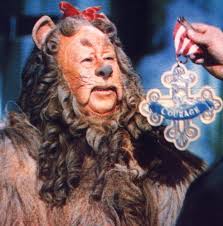
In Oz, the Lion ultimately found his courage (left) and there really are such things as "Wicked Witches" and "Flying Monkeys."


Lions and Tigers and Bears:

We Need Democrats in the

Fight to Defend the Emerald City


A few weeks ago my local 24-screen stadium-seating mega movie-plex had a special screening of the 1939 classic The Wizard of Oz. Never having seen it before on a large screen (let alone a huge one) I thought I should see what the flying monkeys look like when liberated from the confines of television. I can faithfully report that the monkeys are really terrifying and Margaret Hamilton’s performance as the Wicked Witch of the West is only done true justice when she’s 20 or more feet tall.

Inadvertently, I also came away with some other revelations from the giant screen experience – while Wizard is couched as a children’s story, it actually makes some pretty stark statements about good and evil and what to do about that aforementioned evil.

We are shown that the citizens of Oz, be they Munchkins, residents of the Emerald City or even the Wizard himself are all living in terror of the two Wicked Witches, those of the East and the West – so much so that when Dorothy (spoiler alert if you never grew up as a kid in America) upon her arrival to Oz kills (or her house kills) the Wicked Witch of the East; the Munchkins lay on a spontaneous parade of joy – hailing Dorothy for killing the former owner of the ruby slippers.

When towards the end of the movie Dorothy (with the help of Toto, the Lion, the Scarecrow and the Tin Man) “liquidates” the Wicked Witch of the West, even the witch’s own soldiers are beside themselves with relief and happiness. There was no relativism or ambiguity about the bad guys (or gals) and no guilt in rejoicing at the witches’ demise.

While The Wizard of Oz is fantasy, like many fairy tales, it was meant to impart to its juvenile audience that evil really does exist (even in a candy-coated place like Oz), that it’s frightening, but that it can be overcome when good people band together to fight it.

Much as there was great evil in the real world of 1939 there is a whole lot of bad stuff going on in the real world of 2015, no matter how much we’d like to sugarcoat it or escape to somewhere over the rainbow to avoid it.

We face the dangerous and devious machinations of a Wicked Wizard of the East in the form of Russia’s President Vladimir Putin. He’s just signed a military cooperation deal with Iran which provides for joint military exercises and training along with pledges of cooperation against US “interference.” Putin arms Syria’s genocidal Bashir Assad and through Iran indirectly enables Hezbollah and Hamas, the twin Iranian proxies on Israel’s borders. Iran is also menacing Yemen and the Arabian Peninsula through its auxiliaries there. Mr. Putin also has a sophisticated Russian spy ship in Havana harbor and is planning Russian military bases in Cuba, Venezuela and Nicaragua. Let’s not forget his ongoing bullying of the Ukrainians.

And talking about the Hussars of the Wicked Witch of the West’s army and her squadron of flying monkeys – we’re now dealing with the crucifying and decapitating ISIS hordes rampaging across Sunni Mesopotamia; the resurgent Taliban in Afghanistan; a resurrected Al Qaeda exporting wanton murder and mayhem across the world and the Nigerian Boko Haram rolling all Pol Pot-style by eradicating whole villages of non-Muslims and other opponents. Let’s not forget the A-bomb seeking Ayatollahs in Teheran – they’ve got intercontinental ballistic missiles sitting on launch pads with guidance systems aimed squarely at the West. It’s always “Death to America” and “Death to Israel” and these people mean it. This is not make-believe, it’s all too real, just ask the Charlie Hebdo survivors in Paris

From 1939 to 1945 advances in technology didn’t deter the forces of evil – in fact technology enabled the more efficient killing of millions. Our web, wifi and cloud-based world of today is not a shield against nefarious maniacs – to the contrary, our new technologies are a boon to their efforts, not a civilizing palliative. In World War II it was only by mustering a greater resolve and greater determination that evil was vanquished – and at great cost to humanity.

For most of the 20th Century it was the Democratic Party in the US that was at the forefront in the fight for freedom – from Woodrow Wilson through Truman, JFK and LBJ. The Republicans were the isolationists with their heads in the ground.

In January 1941, with much of the West under the thumb of fascism and with external threats against the US mounting each day, Franklin Delano Roosevelt in his State of the Union Address said that “thinking of our children and their children, we oppose enforced isolation for ourselves or for any part of the Americas” because “the democratic way of life is at this moment being directly assailed in every part of the world…We must always be wary of those who…preach the ‘ism’ of appeasement…enduring peace cannot be bought at the cost of other people’s freedom.”

FDR asserted that America needed to be front and center in the fight for what he called “The Four Freedoms.” They are “the freedom of speech, the freedom of worship, the freedom from want, and freedom from fear.” Just as in 1941, civilization is under attack from those who trample upon and make a mockery of freedom and human rights. The difference today is that we’re perhaps at the “1933” place on the dial, not 1941. The key is to ensure our world doesn’t see the equivalent of 1941 in 2017or 2018.

A sure sign that most Americans still believe in good and evil, in the Four Freedoms, in America’s leadership role in ensuring a better world for all mankind is the resounding box office success of the new Clint Eastwood film American Sniper. Yes, it’s a great piece of movie-making and Bradley Cooper turns in a stellar performance reaching way beyond his prior goofy roles, but the film is resonating with Americans in a big way because it shows American leadership in the struggle against the bad guys and portrays what most Americans want our country to stand for. Jack Kennedy would have scoffed at calling this a “Republican movie” as some critics have dubbed it.

Back in Oz the Lion needed to find his courage, and find it he most certainly did because of his love for Dorothy. Since Vietnam vast swaths of the Democratic Party have become averse to the legacies of Harry Truman and JFK when it comes to projecting American force in the world.  Sometimes the only way to save the Munchkins and create security for the Emerald City is by liquidating witches and hobgoblins, however difficult that may be. Democrats need to love liberty as much as the Lion did Dorothy and join arm in arm with Republicans here and our allies abroad in a global effort to protect the yellow brick road so that all of humanity (not just Americans) can enjoy lives blessed with peace and freedom.

Thursday
Dec252014

The Zeitgeist

Christian Bale (left) as Moses and Joel Edgerton as the Pharaoah Ramses the Great in Ridley Scott's Exodus: Gods and Kings.


Ridley Scott’s Exodus:

Splitting the Sea for a Whole New Generation


Ridley Scott is no Cecil B. DeMille. That’s not necessarily a bad thing. What it means is that Scott’s new epic Exodus: Gods and Kings is as much a product of our high-tech new-millennium era as The Ten Commandments was of the Eisenhower gray-flannel suit period.

Scott has crafted a big picture – and not just because of the excellent 3-D effects (this film really ought to be seen in 3-D) – but because it tackles one of history’s most dramatic events with the scope, breadth and grandeur it calls for. To the viewer it seems as though no expense was spared in recreating ancient Egypt, right down to every pyramid, sword, sandal and piece of body armor. The verisimilitude is so exact that in this respect, DeMille’s sets seem cheap by comparison and DeMille spent a fortune.

Scott (and DeMille) tells us the story of Moses from the Bible’s Book of Exodus, from his early years as a prince of Egypt through the giving of the Ten Commandments. Scott takes great dramatic liberties with the biblical narrative. For Bible literati, Scott’s deviations and interpretations from the actual text can be maddeningly frustrating. Like DeMille, Scott relegates Moses’ brother Aaron to a peripheral role. Aaron just can’t get any respect in these cinematic versions of the Exodus story. Scott does away with a lot of the face-to-face confrontations between Moses and Ramses during the plagues period and he dispenses entirely with the pillar of cloud and fire that was one of the analog special effects masterpieces of the DeMille film and that is a critical part of the written story.

Moses’ first encounter with God is depicted agnostically, perhaps inadvertently, perhaps not. Moses gets hit in the head by a big rock and awakens to what his wife tells him later was a hallucination from a probable concussion. The Almighty is depicted throughout the film as a cherubic messenger in the form of a little boy with a thick English accent that only Moses can see – this is another major divergence from the written account.

Initially, Moses returns to Egypt from Midian intent on mounting a guerilla-style insurrection against Pharaoh. While this notion of partisans battling the fascists is very romantic and will probably play well in certain Israeli precincts, this never happened. God (in the form of the little British boy) has to convince Moses to let him do the heavy lifting in the form of the Ten Plagues.

The Plagues are where Scott’s movie shines brightest. His crocodiles, frogs, boils, hail; locusts, darkness and smiting the Nile with blood are all exceptionally well imagined and executed. The final plague of the killing of the Egyptian first born is probably the only one that falls short, with DeMille’s green fog representing the Angel of Death having greater dramatic and visual impact.  Given that Scott had today’s computer generated graphics and effects at his disposal only enhances my admiration for DeMille’s hand-made plagues and effects that were often crafted out of whole cloth or painted in frame by frame.

The apex of the movie (as it should be) is the splitting of the Red Sea. Here, Scott is true to the biblical account of a strong wind gradually blowing the water aside and his depiction of the crashing down of the sea on the Egyptian soldiers and their chariots is masterful.

Christian Bale is probably the best celluloid Moses since Charlton Heston. He’s dashing. He’s manly. He’s smart. He’s heroic. He can also remind you of Batman (one of his prior screen roles) in that he’s got the same somber moralistic tone in both parts. Bale has been playing a bunch of Jews lately. As New York Jewish con man Irving Rosenfeld in American Hustle he gives a tour de force performance of a despicable Jew whereas in Exodus he shows us the diametric, idealized opposite.

Scott reaches back to his 2000 masterpiece Gladiator for the casting and presentation of the Pharaoh Ramses the Great played by Joel Edgerton in what can only be described as full Joaquin Phoenix mode. Nothing Yul Brenner-ish about him. Edgerton’s Pharaoh could easily be mistaken for Phoenix’s Emperor Commodus, right down to the dynamic between him, his father Seti I and Moses (in the same way as it was between Commodus, Marcus Aurelius and Russell Crowe’s Maximus). No one who unworthily inherits the crown can be expected to be noble and he will get his comeuppance. Our hero will have his revenge either in this world or the next.

The great thespian surprise of the film is John Turturro as Pharaoh Seti I – this role is a significant departure from Turturro’s typical performances and shows that Turturro actually has great range and ability beyond the quirky roles of Barton Fink or as Jesus Quintana in The Big Lebowski. Turturro plays a very believable Pharaoh and helps ground the first part of the film.

What Exodus lacks is the plethora of character actors who populated DeMille’s film – people like Edward G. Robinson, Vincent Price, John Carradine, and Anne Baxter as the leering, venal and narcissistic Neferteri. Scott’s bringing in of Ben Kingsley (dull) and Sigourney Weaver (playing a stiff WASP matron in Egypt) isn’t enough to give Exodus a dash of wit. At nearly two and a half hours, Exodus needs some humor and light moments and seems to run longer than the actually much lengthier Ten Commandments.

Is Exodus worth seeing? Absolutely. A great film for our time? You bet. Something that we’ll be watching every year as a ritual some 50 or more years from now like the DeMille film? Probably not. Will it hold up as well as Gladiator? Maybe not. But it’s worth the price of admission just for the plagues and the Red Sea in 3-D.